Removal of Windows Diagnostic Malware

How Did My Computer Become Infected with Windows Diagnostic malware?
More likely than not, you visited an infected web page and were then infected with the trojan behind the rogue virus called Windows Diagnostic. Virus writers are becoming experts in SEO (search engine optimization) and are getting infected sites ranking very high in the search engines. Although these sites only rank high for a short time, they can do tremendous damage while they are showing up.In this particular case, the computer I was cleaning up was infected when its owner went to the following sites from a Google search.
http://www.discountesteelauder.co.cc/78ke
http://www.mainezoocoupons.co.cc/bi4k
Neither site is operational now, but they did show up in search results and helped infect the computer with some nasty rogue malware called Windows Diagnostic. This malware is virtually identical to a number of other drive utility type scareware products like Windows Repair, Windows Scan, Windows Safe Mode, Windows Disk, and Windows Restore. It shows a PC Performance & Stability report and scares you into thinking your computer is about to crash...unless you purchase the product.
What Does Windows Diagnostic malware look like?
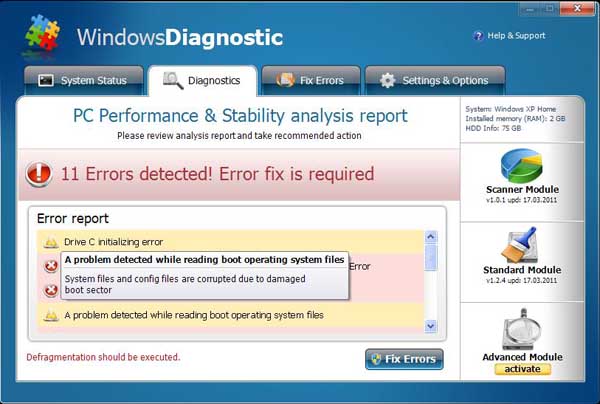
The Windows Diagnostic malware presents a "PC Performance & Stability Report" when it pops up on your computer. This report shows the same sorts of alerts that many rogue antivirus type programs show. However, it takes things a step further. Instead of showing viruses, trojans, and other malicious programs that have invaded your computer, it tells you that your hard drive and computer are crashing with a variety of messages such as:
"Hard Drive Failure The system has detected a problem with one or more installed IDE / SATA hard disks. It is recommended that you restart the system"
"System Error An error occurred while reading system files. Run a system diagnostic utility to check your hard disk drive for errors"
"Critical Error Hard drive critical error. Run a system diagnostic utility to check your hard disk drive for errors. Windows can't find hard disk space. Hard drive error"
"Fix Disk Windows Diagnostic Diagnostics will scan the system to identify performance problems. Start or Cancel"
"Windows Diagnostic Diagnostics Windows detected a hard disk error. A problem with the hard drive sectors has been detected. It is recommended to download the following sertified <sic> software to fix the detected hard drive problems. Do you want to download recommended software?"
"Requested registry access is not allowed. Registry defragmentation required Read time of hard drive clusters less than 500 ms 32% of HDD space is unreadable Bad sectors on hard drive or damaged file allocation table GPU RAM temperature is critically high. Urgent RAM memory optimization is required to prevent system crash Drive C initializing error Ram Temperature is 83 C. Optimization is required for normal operation. Hard drive doesn't respond to system commands Data Safety Problem. System integrity is at risk. Registry Error - Critical Error"
"Critical Error! Damaged hard drive clusters detected. Private data is at risk"
"Critical Error Hard Drive not found. Missing hard drive"
"Critical Error RAM memory usage is critically high. RAM memory failure"
"Critical Error Windows can't find hard disk space. Hard drive error"
"Critical Error! Windows was unable to save all the data for the file \System32\496A8300. The data has been lost. This error may be caused by a failure of your computer hardware"
"Critical Error A critical error has occurred while indexing data stored on hard drive. System restart required"
"System Restore The system has been restored after a critical error. Data integrity and hard drive integrity verification required"
"Activation Reminder Windows Diagnostic Activation Advanced module activation required to fix detected errors and performance issues. Please purchase Advanced Module license to activate this software and enable all features"
"Low Disk Space You are running very low disk space on Local Disk (C:)"
What Does the Windows Diagnostic malware do to your system?
First of all, this program disables Task Manager so that it makes removing the pest that much harder. Beyond the fact that it pops up the annoying messages virtually non stop, it also does something even more devious, it sets the hidden attribute on virtually all files on the hard drive, so the desktop, Start Menu, Documents, etc show as blank. From the novices point of view, it appears the virus wiped all the information from the hard drive. A very scary thought indeed.
Because of the widespread havoc this malware causes, there are many steps involved in removing it
First read this information on how to fix the task manager and re-enable it,
Can I Remove Windows Diagnostic manually?
To try to remove the Windows Diagnostic malware manually you'll need to complete the following tasks. However, if you delete the wrong item in the registry it could render your computer unbootable. For this reason, do not try to remove this malware manually unless you are experienced in deleting files and removing items from the registry. In reality, its much easier to use a program such as Malwarebytes Anti-Malware to clean the system. This is covered in my step-by-step procedure below.
Stop Windows Diagnostic processes:
[random name].exe
Disable Windows Diagnostic DLL files:
%AllUsersProfile%\Application Data\[random].dll
Delete Windows Diagnostic Registry Entries:
HKEY_CURRENT_USER\Software\Microsoft\Windows\CurrentVersion\Run “[random].exe”
HKEY_CURRENT_USER\Software\Microsoft\Windows\CurrentVersion\Run “[random]”
HKEY_CURRENT_USER\Software\Microsoft\Windows\CurrentVersion\Policies\Associations “LowRiskFileTypes” = ‘/{hq:/s`s:/ogn:/uyu:/dyd:/c`u:/bnl:/ble:/sdf:/lrh:/iul:/iulm:/fhg:/clq:/kqf:/`wh:/lqf:/lqdf:/lnw:/lq2:/l2t:/v`w:/rbs:’
HKEY_CURRENT_USER\Software\Microsoft\Windows\CurrentVersion\Policies\Attachments “SaveZoneInformation” = ’1′
HKEY_CURRENT_USER\Software\Microsoft\Internet Explorer\Download “CheckExeSignatures” = ‘no’
HKEY_CURRENT_USER\Software\Microsoft\Internet Explorer\Main “Use FormSuggest” = ‘yes’
HKEY_CURRENT_USER\Software\Microsoft\Windows\CurrentVersion\Internet Settings “WarnonBadCertRecving” = ’0′
HKEY_CURRENT_USER\Software\Microsoft\Windows\CurrentVersion\Policies\System “DisableTaskMgr” = ’1′
Remove Windows Diagnostic files:
%AllUsersProfile%\Application Data\~[random]
%AllUsersProfile%\Application Data\~[random]
%AllUsersProfile%\Application Data\[random].dll
%AllUsersProfile%\Application Data\[random].exe
%AllUsersProfile%\Application Data\[random]
%AllUsersProfile%\Application Data\[random].exe
Step by Step Procedure for Removing Windows Diagnostic malware
1) Restart Your Computer in Safe Mode (with Networking) by pressing F8 when the computer boots and selecting the appropriate option.
2) If the malware program appears to still pop up even in Safe Mode, then follow these extra steps.
- Click on Start, Run and type MSCONFIG and Press Enter (For Windows XP)
- Click the Start Orb and type MSCONFIG and Press Enter (For Windows Vista and 7)
- In the System Configuration Utility, click on the Startup tab and look for an entry that appears to be a random character named .exe file. In my case, the file was LoEwouCqpDax.exe. As you can see the file name is just a bunch of random characters and should be fairly easy to spot in the Startup section.
- Once you've located this filename, uncheck it and click Ok. When the computer asks to restart, go ahead and restart in Safe Mode as in Step 1.
3) Now that the computer is somewhat stable, open a web browser and download Malwarebytes Anti-Malware from their site
4) After Malwarebytes has downloaded, install it and try to update it. In one particular occasion, it was unable to update and I had to update it manually. In order to update Malwarebytes manually, you'll need to download the mbam-rules.exe file and run it.
5) Now proceed to run Malwarebytes Anti-Malware and remove any problems it finds.
6) After cleaning and rebooting the system, you may be still experiencing a very annoying aspect of this trojan. It hides files over the entire hard drive. Yes, you can simply go into the system and Show Hidden Files, but this unhides system files and other Windows files that should not be deleted. By hiding these important files, you aren't going to delete something you really need by accident. So, how do we unhide the normal files, but keep the system files hidden? With a command prompt command!
To Unhide files and folders that Windows Diagnostic and other programs hide
For Windows XP
1) Click on Start, Run
2) Type CMD and press Enter
3) At the command prompt type the following and press Enter
CD \
4) Now the command prompt should show the root folder of the hard drive. Most likely C:\
5) At the command prompt type the following and press Enter
ATTRIB -H *.* /S /D
This command will unhide the files that are currently hidden. Because the important system files have a system attribute attached to them as well, the above command will not work for them and they will be skipped and kept hidden from prying eyes.
This command will take some time, so dont be afraid if it takes anywhere from a few minutes to half an hour to finish. What the command does is simple. It removes the hidden attribute from all files on the hard drive. The /S parameter tells it to search the current folder and all subfolders, while the /D parameter processes tthe folders as well.
6) Type Exit and press Enter when the procedure is complete. Then reboot your computer
For Windows Vista/7
1) Click on Start, All Programs
2) Click Accessories and Find Command Prompt
3) Right click on the Command Prompt option and choose Run as Administrator
4) At the command prompt type the following and press Enter
CD \
5) Now the command prompt should show the root folder of the hard drive. Most likely C:\
6) At the command prompt type the following and press Enter
ATTRIB -H *.* /S /D
This command will unhide the files that are currently hidden. Because the important system files have a system attribute attached to them as well, the above command will not work for them and they will be skipped and kept hidden from prying eyes.
This command will take some time, so dont be afraid if it takes anywhere from a few minutes to half an hour to finish. What the command does is simple. It removes the hidden attribute from all files on the hard drive. The /S parameter tells it to search the current folder and all subfolders, while the /D parameter processes tthe folders as well.
7) Type Exit and press Enter when the procedure is complete. Then reboot your computer
Run a Thorough Virus Scan
Finally, as an extra precaution, scan your computer with online virus scanner like Housecall, BitDefender, or eTrust or download and install an antivirus program and run a complete scan. A list of online scanners is below, some however will only scan but not remove issues.
Online Virus Checkers
Trend Micro Housecall - will scan and remove threats
BitDefender Scan Online - will scan and remove threats
ESet (NOD32) Online Scanner
Kaspersky Online Scan - will scan and remove threats
Panda Activescan - appears to only scan for but not remove threats
McAfee FreeScan - appears to only scan for but not remove threats
eTrust Antivirus Web Scanner - will scan and remove threats
Symantec Security Check - will scan and remove threats
Dr.Web Online Check - user can upload and test for threats on particular files
Trojan Scanner
TrojanScan by WindowsSecurity.com
Spyware Scanners
Malwarebytes AntiMalware
Super AntiSpyware
Spybot Search and Destroy
Congratulations! Your computer should be free of the Windows Diagnostic, Windows Restore, Windows Repair or other similar named nasty.
Links to Other Important Information
Support for Windows XP and Windows Vista without latest service packs ends in 2010
How to Fix 500 Internal Server Error in PHP 5.4 script
Computer shows Stop error and Continously Reboots after SP3 installed.
Product Key Does Not Match Current Windows SKU Error
Review of FastAgain PC Booster and How to Uninstall it
How to Remove MSBLAST.EXE worm
How to Remove Content Advisor Password in Internet Explorer
How to Fix Google Chrome not Opening Web Pages or Settings
How to Remove Incredimail Automatically
How to Fix Problem of Limited or No Connectivity After installing Windows XP Service Pack 2
How to Recover From a Corrupted Registry in Windows XP
How to Speed Up Windows Boot Time
Acer ERecovery Service is Not Available
Acer Recovery CD Restore Failed Reason: 0xf0000051
How to Fix Problem with No Active Mixer Devices Available in Windows XP
Parents Guide to MySpace.com - a report every parent should read
Save and Restore Desktop Layout of Icons
What is Windows Genuine Advantage and How to Overcome Problems With It
Change Forgotten Administrator Password in Windows XP/2000/Vista
Not Enough Server Storage Error When Connecting to Computer on Network
Installing Windows Vista Upgrade on a Blank Hard Drive
How to Delete Your Windows Vista Logon Password
Remove Unwanted Icons from the Windows Vista Welcome Center
Cannot Connect to Network Printer with Windows Vista
How to Wipe, Delete, Degauss, and Destroy Data on a Hard Drive
Fixing RTHDCPL.EXE - Illegal System DLL Relocation Error in Windows XP
How to Fix Blank or Missing Title Bar in IE9
Unable to Open New Tab in IE9 - Spinning Favicon
Fix 404 Errors for /apple-touch-icon-precomposed.png and /apple-touch-icon.png
What is the Config.Msi folder and Can I Delete It?
Flash Player Installation Issues
How to Set Yahoo Mail as your Default Email Program
Unknown File in Winsock LSP - NWPROVAU.DLL - Can it be Removed?
How to Delete a Service in Windows Vista
How to Disable the On-Screen Keyboard in Windows Vista
What is CTFMON.EXE and How Can I Remove It
How to Export MSN Favorites to Internet Explorer
How to Fix Registry Editing Has Been Disabled By Your Administrator Error
How to Change Default Editor in Windows and Fax Viewer
How to Fix Problem when Windows Security Center reports multiple antivirus programs installed
How to Fix Problem when Windows Updates will download but will not install
How to Fix Problem when Windows Automatic Updates Service wont Start
Cannot Download Files With Internet Explorer
How to Keep Your Computer Up-to-Date
How to Fix the Prompt for Click to Run an ActiveX Control on this webpage
How to Remove "This Page Contains Both Secure and NonSecure Items" Warning Message
How to Fix Problem with Blank Add/Remove Control Panel
How to Fix Windows Vista Update Error 80244019
Troubleshooting An Error Occurred During Directory Enumeration
How to View and Decipher Minidump files created by Blue Screen error messages
How to Fix BLService Error on HP Computer in Vista
Google Adsense Hijacking - How to Respond
Windows Defrag Does Not Complete
Review of BigString Recallable Email
Fix Incorrect Time Stamp on Hotmail Messages
Deleting or Editing Typed URLs in the Internet Explorer Address Bar
Belarc Advisor - Quick Computer Inventory Software
How to Get Out of Full Screen Mode in Internet Explorer
How to Correct Missing "Copy to CD" option in My Pictures Tasks
How to Fix Code 39 error with CD or DVD Drive
How to Fix Problems When Windows Installer Popups Error With Missing .MSI Files
How to Fix Problems When Network Setup Wizard and Network Connections Won't Open
How to Fix Problems with Windows Help Errors
How to Delete Individual Entries from Run Command History
Foxit - Adobe Reader Alternative
How to Fix Autochk Program Not Found error
Difference between Master/Slave and Cable Select on a Hard Drive
How to Use Microsoft SyncToy to backup your important files
How to Delete Temporary Internet Files, Cookies, and History files
Review of PCDecrapifer Software Removal Tool
How to Fix Security Flaw in Adobe Reader
Computer Speakers Sound like Chipmunks
How to SVCHOST.EXE Application Error 0x745f2780
Troubleshooting the Unmountable Boot Volume Error in Windows XP
How to Disable, Uninstall, and Remove Windows Messenger instant messaging from Windows XP
How to Remove Windows Messenger in Windows XP
Free DVD Decoder Software and Help
Free CD Burning Software and Help
How to Use Remote Desktop to Access Multiple Computer on Your LAN
HijackThis Tutorial for removing Spyware
Review of Adsense Detective, Getting Stats and Results from Adsense
How to Disable System Restore in Windows ME or Windows XP
How to Uninstall Internet Explorer 7
How to Install NetBEUI in Windows XP
What is the KB891711.exe file in Windows 98 or Windows ME?
How to Troubleshoot and Solve USB Device Error Code 10
Spooler Subsystem App has encountered a problem and needs to close Error and How to Fix it
How to Fix Problem opening Microsoft Outlook
How to Disable News Headlines in Netscape
How to Bring Back Missing Folders in Netscape Communicator
How to Fix Access Denied Error when Using MSCONFIG
How to Fix HPQKBFiltr.Sys Keylogger Error in Kaspersky Antivirus
How to Backup and Restore Outlook Express Mail, Address Book, Blocked Senders List and other Settings
How to Fix Error 501 Permission Denied when changing fonts in Outlook Express
What is the Tilde (~) File on my Desktop?
What is the thumbs.db file and can I remove it
Password is Not Saved in Outlook Express or Outlook in Windows XP
Allow Viewing of Attachments in Outlook Express 6
How to Fix Problem of No Spell Check in Outlook Express
How to Fix Problems Viewing or Accessing Secure Web Sites
How to Start or Boot Windows into Safe Mode
What is the Winmail.dat file attached to emails?
How to Correct Unreadable Fonts in Norton Antivirus or Norton Systemworks
How to correct issue with No Visible Menu Bar or Tabs in Windows XP Task Manager
How Disable/Enable the Windows XP Welcome Screen
How to Fix RTLGINA2.DLL error with Windows XP Welcome Screen and Netgear WG111
How to Fix Windows Update Error 0x80070420
PopUp Ad Removal Software and Help
Review of ErrorNuker program to identify and fix problems with the Windows Registry
| Search PCHell.com |
|
| site search by freefind | advanced |
Top 10 PCHell.com Pages
- POST Beep Codes
- How to Uninstall McAfee
- How to Start Windows in Safe Mode
- My Clean PC Review
- How to Fix Code 39 Error
- How to Manually Run the Microsoft Malicious Software Removal Tool
- How to View and Decipher Minidump Files
- How to Uninstall Norton
- What is the WinMail.dat File?
- My Web Search Removal Help
Ten Steps to Trouble-Free Computing
- Know Your System
- Create an Emergency Boot Disk
- Tune Your Hard Drive
- Store With a Plan
- Backup Your Data
- Keep Your System Virus Free
- Stick with the Program
- Keep Up-to-Date
- Keep It Clean
- Shut Down Gracefully
iPadastic - News, Tutorials, Help, Tips, and Hints for the iPad
Download Hoyle Games
including Casino 3D, Card, Board, and Solitaire games.
Tribute to Adrian Cole
Victim of Child Abuse